
The Ultimate Guide to Agency Sales in the Age of AI
The digital marketing landscape has undergone seismic shifts in recent years, but none as profound as the integration of artificial intelligence into search engines and client decision-making processes. For agencies that have traditionally relied on SEO traffic and organic discovery, the rise of AI-powered search responses presents both unprecedented challenges and unique opportunities.
This comprehensive guide explores how forward-thinking agencies can not only survive but thrive in this new paradigm, transforming potential threats into competitive advantages.
The New Reality: How AI is Reshaping Agency Discovery
The Search Traffic Challenge
Traditional search engine optimization has been the backbone of agency lead generation for over two decades. Agencies invested heavily in content marketing, keyword optimization, and technical SEO to capture potential clients at the moment of intent. However, AI-powered search engines are fundamentally changing this dynamic.
When someone searches "best digital marketing agency for SaaS companies," they're increasingly receiving comprehensive AI-generated responses that synthesize information from multiple sources. These responses often provide detailed recommendations without requiring users to click through to individual agency websites. The result? A dramatic reduction in organic traffic to agency sites, even for those ranking well in traditional search results.
The Trust and Credibility Shift
Beyond traffic reduction, AI responses are creating a new layer of intermediation between agencies and prospects. Potential clients are forming initial impressions and making shortlists based on AI-curated information rather than direct website visits. This shift means agencies must optimize not just for search engines, but for AI systems that interpret and synthesize their information.
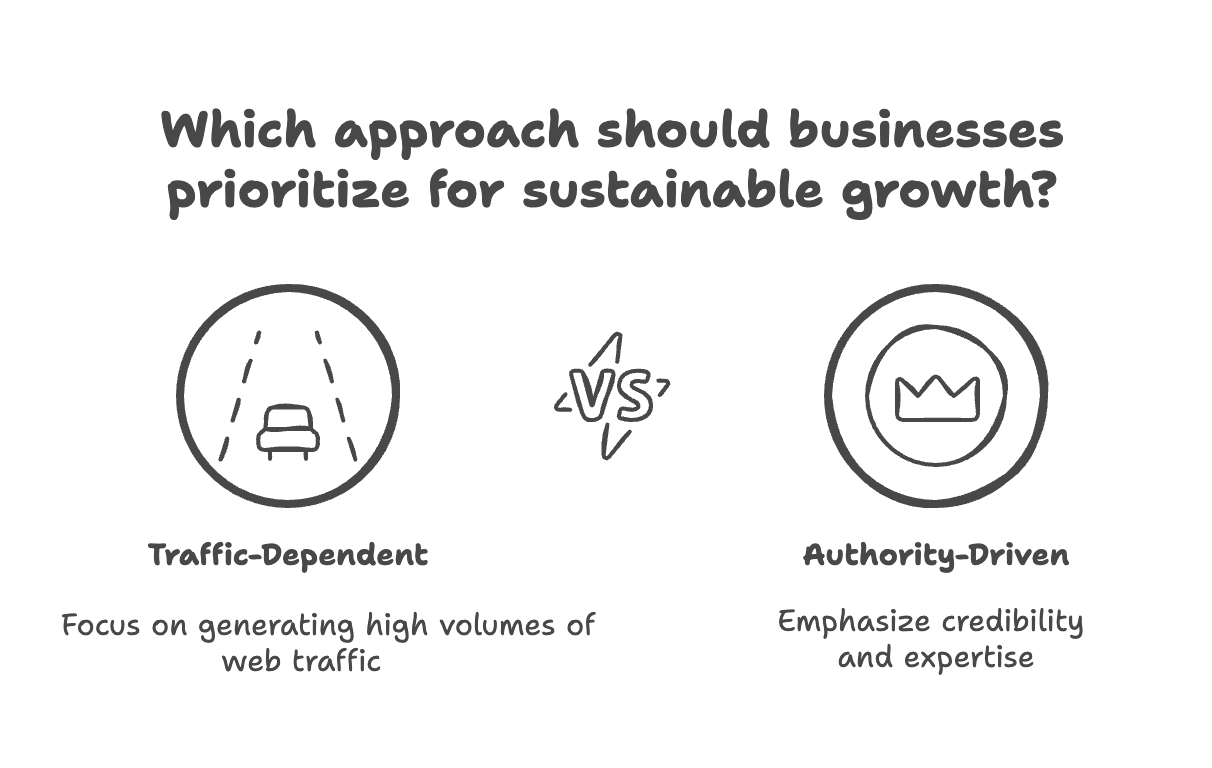
Strategic Pivot: From Traffic-Dependent to Authority-Driven
Building Multi-Channel Authority
The most successful agencies in the AI era are those that diversify their authority-building efforts across multiple channels. Rather than relying solely on their website's SEO performance, they're establishing thought leadership through:
Content Syndication Networks: Publishing insights across industry publications, guest posting on established platforms, and contributing to relevant forums where their expertise can be discovered and referenced by AI systems.
Social Proof Amplification: Leveraging client testimonials, case studies, and success stories across various platforms to create a comprehensive digital footprint that AI systems can analyze and reference.
Industry Recognition Programs: Actively participating in awards, certifications, and industry recognition programs that provide third-party validation of their expertise.
The Personal Brand Integration Strategy
AI systems often give significant weight to personal authority when evaluating agencies. Successful agencies are investing in building the personal brands of their key team members, particularly founders and practice leads. This involves:
- Regular speaking engagements at industry events
- Thought leadership content attributed to specific individuals
- Active participation in professional networks and communities
- Strategic use of professional social media platforms
Platform Optimization for AI Discovery
Understanding AI Training Data Sources
To appear in AI responses, agencies must understand where these systems source their information. Current AI models are trained on diverse datasets that include:
- Published articles and industry publications
- Professional networking platforms
- Review and rating websites
- Directory listings and business profiles
- Social media content and discussions
Smart agencies are ensuring their presence across all these channels, with consistent messaging and up-to-date information.
Structured Data and Schema Implementation
While traditional SEO focused on keywords and backlinks, AI optimization requires a more structured approach to information presentation. Agencies should implement comprehensive schema markup that clearly defines:
- Service offerings and specializations
- Team credentials and expertise areas
- Client industries and company sizes served
- Geographic service areas
- Pricing models and engagement types
This structured data helps AI systems understand and categorize agency capabilities more accurately.
The PureRank Advantage: Merit-Based Discovery in an AI World
Why Traditional Directories Fall Short
Most agency directories operate on a pay-to-play model where visibility is determined by advertising spend rather than actual capability. This creates a fundamental misalignment with how AI systems evaluate and recommend services. AI models are increasingly sophisticated at identifying and prioritizing genuine merit over paid placement.
PureRank's Merit-Based Approach
PureRank represents a paradigm shift in agency discovery by focusing exclusively on demonstrable expertise and results rather than advertising budgets. This approach aligns perfectly with how AI systems evaluate and recommend services.
AI-Optimized Profile Architecture: PureRank profiles are specifically designed to provide AI systems with the structured, comprehensive data they need to make accurate recommendations. This includes detailed capability matrices, verified client results, and standardized performance metrics.
Verification and Validation Systems: The platform's emphasis on verified capabilities and results means that AI systems can reference PureRank profiles with greater confidence, leading to more frequent and prominent recommendations.
Dynamic Capability Matching: PureRank's sophisticated matching algorithms help ensure that agencies appear in AI responses for relevant queries, increasing visibility without the need for traditional SEO tactics.
Maximizing Your PureRank Presence
To fully leverage PureRank's AI-friendly architecture, agencies should:
Complete Comprehensive Profiles: Provide detailed information about services, methodologies, team expertise, and past successes. The more complete the profile, the better AI systems can understand and recommend your agency.
Actively Collect and Showcase Client Feedback: PureRank's review system is designed to capture nuanced feedback that goes beyond simple star ratings. This detailed feedback provides AI systems with rich context for making recommendations.
Regularly Update Capabilities and Case Studies: Keep profiles current with latest services, team additions, and recent client successes. AI systems favor fresh, regularly updated information.
Engage with the PureRank Community: Participate in discussions, share insights, and contribute to the platform's knowledge base. This engagement signals to AI systems that your agency is active and authoritative in your field.
Direct Relationship Building in an AI-Mediated World
The Renaissance of Relationship Marketing
As AI intermediates more of the initial discovery process, the value of direct relationships has paradoxically increased. Agencies that invest in building genuine relationships with prospects, partners, and industry influencers create pathways that bypass AI-mediated discovery entirely.
Strategic Partnership Development: Building relationships with complementary service providers, technology vendors, and industry consultants creates referral networks that operate independently of search-based discovery.
Client Advisory Programs: Developing formal advisory relationships with key clients creates ongoing touchpoints and opportunities for organic referrals that don't rely on search visibility.
Industry Thought Leadership: Taking positions on industry trends and participating in professional discourse helps establish direct mind-share with potential clients.
Account-Based Marketing Evolution
Traditional account-based marketing focused on identifying and targeting specific prospects through digital channels. In the AI era, this approach requires evolution toward more sophisticated, multi-touch strategies:
Research-Driven Personalization: Using AI tools to research prospects' specific challenges and crafting highly personalized outreach that demonstrates deep understanding of their business context.
Content Customization at Scale: Creating content assets that can be dynamically customized for specific prospects while maintaining the personal touch that differentiates human expertise from AI-generated responses.
Multi-Channel Orchestration: Coordinating touchpoints across email, social media, industry events, and personal networks to create comprehensive engagement strategies.
Content Strategy for AI-Optimized Discovery
Beyond Keywords: Semantic Authority Building
Traditional content marketing focused on keyword density and search volume. AI-optimized content strategy requires a more sophisticated approach that demonstrates genuine expertise and provides comprehensive value.
Topic Cluster Development: Creating comprehensive content ecosystems around core expertise areas, with interconnected pieces that demonstrate deep knowledge and varied perspectives.
Problem-Solution Mapping: Developing content that clearly articulates common client challenges and provides specific, actionable solutions that showcase agency capabilities.
Methodology Documentation: Publishing detailed explanations of proprietary processes and methodologies helps establish unique positioning and gives AI systems specific frameworks to reference.
Video and Interactive Content Integration
AI systems are increasingly capable of analyzing and referencing multimedia content. Agencies should invest in:
Educational Video Series: Creating comprehensive video content that explains complex concepts and demonstrates expertise in visual formats.
Interactive Tools and Calculators: Developing useful tools that provide immediate value while showcasing agency capabilities and generating data for AI analysis.
Webinar and Workshop Content: Hosting educational events that can be recorded and referenced, providing rich content for AI systems to analyze and recommend.
Technical Infrastructure for AI Optimization
API-First Content Management
Forward-thinking agencies are restructuring their content management systems to be API-first, allowing for easier syndication and integration with various platforms and AI systems.
Headless CMS Implementation: Using content management systems that separate content creation from presentation, making it easier to distribute content across multiple channels and formats.
Automated Content Distribution: Implementing systems that can automatically distribute content updates across multiple platforms, ensuring consistency and maximizing AI discovery opportunities.
Performance Tracking Integration: Building systems that can track content performance across multiple channels and AI-driven discovery paths.
Data Strategy and Analytics Evolution
Understanding AI-driven discovery requires new approaches to data collection and analysis:
Multi-Attribution Modeling: Developing attribution models that can account for AI-mediated discovery paths and delayed conversion cycles.
Sentiment and Context Analysis: Using AI tools to analyze how agency content and capabilities are being discussed and referenced across various platforms.
Competitive Intelligence Automation: Implementing systems that can monitor how competitors are being referenced in AI responses and identifying opportunities for differentiation.
Future-Proofing Your Agency Sales Strategy
Emerging AI Platforms and Opportunities
The AI landscape continues to evolve rapidly, with new platforms and opportunities emerging regularly. Successful agencies are:
Early Platform Adoption: Identifying and testing new AI-powered platforms for professional service discovery before they become saturated with competitors.
Integration Strategy Development: Building flexible systems that can quickly adapt to new platforms and discovery mechanisms as they emerge.
Continuous Learning Investment: Investing in team education and development to stay current with AI trends and opportunities.
Building Adaptive Sales Processes
The most resilient agencies are those that build adaptive sales processes that can function effectively regardless of how prospects initially discover them:
Discovery-Agnostic Qualification: Developing qualification processes that work whether prospects come from AI recommendations, direct referrals, or traditional search.
Value Demonstration Frameworks: Creating standardized approaches for demonstrating value that can be quickly customized based on prospect source and context.
Relationship Nurturing Systems: Building long-term relationship management systems that maintain connections regardless of immediate sales outcomes.
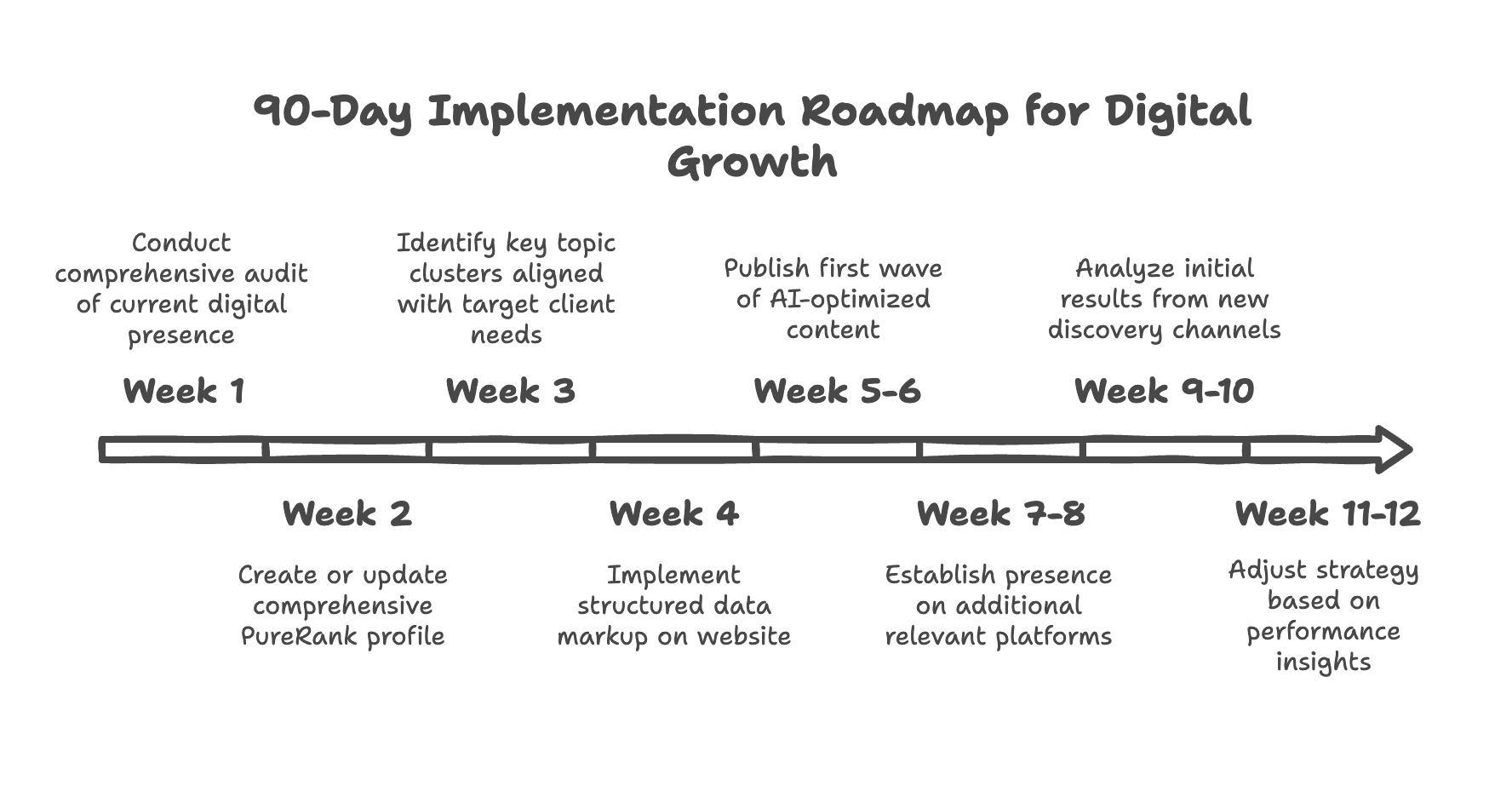
Implementation Roadmap: Your 90-Day Action Plan
Days 1-30: Foundation Building
Week 1: Audit and Assessment
- Conduct comprehensive audit of current digital presence across all platforms
- Analyze current lead generation sources and conversion paths
- Assess team capabilities and resource allocation
Week 2: PureRank Profile Optimization
- Create or update comprehensive PureRank profile
- Gather and organize client testimonials and case studies
- Document core methodologies and service offerings
Week 3: Content Strategy Development
- Identify key topic clusters aligned with target client needs
- Plan content calendar for next 90 days
- Begin development of cornerstone content pieces
Week 4: Technical Infrastructure Setup
- Implement structured data markup on website
- Set up multi-channel content distribution systems
- Establish new analytics and tracking mechanisms
Days 31-60: Execution and Optimization
Week 5-6: Content Production and Distribution
- Publish first wave of AI-optimized content
- Begin systematic social media and professional network engagement
- Launch initial partnership outreach efforts
Week 7-8: Platform Expansion
- Establish presence on additional relevant platforms
- Begin guest posting and thought leadership content development
- Implement client advisory program structure
Days 61-90: Measurement and Refinement
Week 9-10: Performance Analysis
- Analyze initial results from new discovery channels
- Gather feedback from early AI-driven prospects
- Refine content and messaging based on performance data
Week 11-12: Strategy Refinement
- Adjust strategy based on performance insights
- Expand successful tactics and eliminate underperforming efforts
- Plan next quarter's strategic initiatives
Measuring Success in the AI Era
New Metrics for New Realities
Traditional metrics like organic traffic and keyword rankings become less relevant in an AI-mediated world. Forward-thinking agencies are tracking:
AI Mention Frequency: How often the agency appears in AI-generated responses across different query types
Source Authority Scores: The quality and authority of sources that reference the agency
Cross-Platform Consistency: How consistently the agency's expertise is represented across different platforms
Relationship Network Growth: The expansion of direct professional relationships and partnerships
Long-Term Value Indicators
Client Lifetime Value Trends: Whether AI-discovered clients demonstrate different retention and expansion patterns
Referral Rate Changes: How discovery method impacts client satisfaction and referral generation
Market Position Evolution: Whether the agency's market positioning strengthens over time with AI optimization efforts
Conclusion: Embracing the AI-Driven Future
The integration of AI into client discovery processes represents one of the most significant shifts in professional services marketing since the advent of the internet. While this transformation presents genuine challenges for agencies accustomed to traditional lead generation methods, it also creates unprecedented opportunities for those willing to adapt and evolve.
The agencies that will thrive in this new landscape are those that view AI not as a threat to be feared, but as a powerful amplifier of genuine expertise and value. By focusing on merit-based platforms like PureRank, building comprehensive authority across multiple channels, and maintaining the human relationships that remain at the heart of professional services, agencies can not only survive but flourish in the age of AI.
The future belongs to agencies that combine the efficiency and reach of AI-optimized discovery with the irreplaceable value of human expertise and relationship building. By implementing the strategies outlined in this guide, your agency can position itself not just to weather the current transformation, but to emerge stronger and more competitive than ever before.
The AI revolution in agency discovery is not a distant future event—it's happening now. The question is not whether your agency will be affected, but whether you'll be among the leaders who shape this new landscape or the followers who struggle to adapt. The choice, and the opportunity, is yours.